
Batu Punggul: The Complete Guide to Sabah's Most Spectacular Limestone Pinnacle
Batu Punggul: The Complete Guide to Sabah's Most Spectacular Limestone Pinnacle
Those travellers tend to describe it the same way: as the best thing they did in Borneo.
This guide covers everything you need to know before you go, including how to get there, what to expect on the climb, who runs tours to the area, and why Batu Punggul deserves a place at the centre of any serious Sabah itinerary.
What Is Batu Punggul?
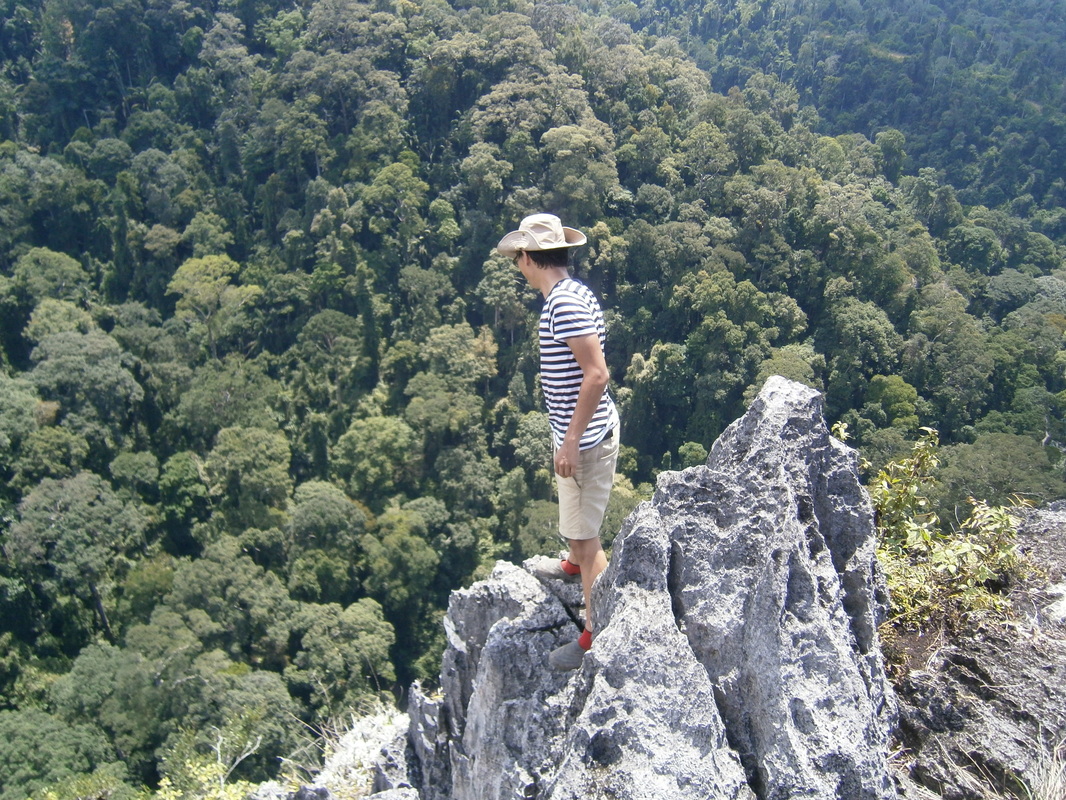
Batu Punggul is a 300-metre limestone pinnacle rising dramatically out of the primary rainforest in the Sapulot district of southwestern Sabah, Malaysian Borneo. It is surrounded on all sides by untouched jungle, with no roads, no cleared land, and no development visible in any direction from the summit.
The name translates loosely from the local Murut language as "the standing rock," and standing at its base, the name makes complete sense. The pinnacle is a sheer limestone outcrop shaped by millions of years of erosion, covered in vegetation on its lower reaches and bare rock near the top. It rises from the jungle floor like something from a film set, except that no film set has ever looked quite like this.
Geologically, Batu Punggul is part of the same limestone karst landscape that produces the famous caves of Mulu and the pinnacles of the Gunung Mulu National Park in Sarawak, though it remains far less visited than either of those destinations. The surrounding forest is ancient primary rainforest, meaning it has never been significantly disturbed by logging or clearing. The biodiversity in the area is extraordinary.
Why Batu Punggul Is Worth the Journey
The honest answer is that most of what makes Batu Punggul special cannot be photographed. The silence of the jungle on the trek to the base. The way the rock changes colour in the afternoon light. The view from the top that makes you understand, viscerally, how large and how intact this forest still is.
But there are practical reasons too.
It is genuinely off the beaten path. The vast majority of tourists who visit Sabah never make it to Sapulot. The area sees a fraction of the visitor numbers of Kinabalu Park or the Kinabatangan River, which means no queues, no crowds, and an experience that feels like a genuine discovery rather than a tick on a checklist.
The climb is accessible. Batu Punggul is not a technical mountaineering route. The approach from the riverbank is a 45-minute trek through jungle, and the climb itself is a free-scale of the rock face, meaning you use your hands and feet on natural holds rather than ropes and harnesses. It is challenging and physical but does not require prior climbing experience. Most people who attempt it reach the top.
The surrounding area is extraordinary. Batu Punggul sits within the Orou Sapulot region, which contains multiple other experiences of equal quality: the sacred Pungiton Cave, the Vangkaakon and Kabulongou waterfalls, the Murut longhouse at Romol Eco-Village, and the longboat journey through white-water rapids to the Kalimantan border. A visit to Batu Punggul is rarely a standalone trip and is almost always part of a wider Orou Sapulot experience.
It is run by the original founders. Tours to Batu Punggul and the wider Orou Sapulot area are operated by the Murut community who created tourism in this region. These are not outside operators running trips through someone else's land. They are the people whose families have lived in this forest for generations, and that changes the quality and depth of the experience entirely.
How to Get to Batu Punggul
Batu Punggul is not the kind of place you drive to and park. Getting there is a journey in itself, and for most visitors, that journey is one of the highlights of the trip.
From Kota Kinabalu
The journey begins in Kota Kinabalu, Sabah's capital on the northwest coast. From KK, the route heads south through the Crocker Range to Keningau, the main town in the interior highlands, a drive of roughly 2.5 to 3 hours depending on road conditions.
From Keningau, the road continues south and then east into the Sapulot district, a further 2 to 3 hours on roads that become progressively more rural as you go. The landscape changes noticeably on this stretch: the agricultural land and palm oil of the Keningau Valley gives way to hills, then forest, then something that feels genuinely wild.
The final section of the journey from the road into the Orou Sapulot area is done by river on traditional wooden longboats, navigated by local boatmen who know every rapid and shallows in the system.
The Practical Reality
Independent travel to Batu Punggul is very difficult. There is no public transport to the Sapulot area, no accommodation available to walk-in visitors, and no marked trail to Batu Punggul that can be followed without a guide. The river sections require local boatmen. The jungle trek requires someone who knows the route.
In practice, all visits to Batu Punggul happen through guided tour packages operated by Orou Sapulot Tours, run by the original Murut founders of the region. All transport from Kota Kinabalu, including 4x4 vehicles for the interior roads and longboats for the river sections, is included in tour packages. This is not a limitation; it is how the area has been set up to work, and it is part of why the experience is so good.
The Climb: What to Expect
The Trek to the Base
From the riverbank where the longboat drops you, a 45-minute trek through primary rainforest brings you to the base of Batu Punggul. The trail passes through old-growth jungle, crosses small streams, and moves through terrain that is humid, green, and alive in every direction.
The trek is not technically demanding but the ground is uneven and can be slippery after rain. Proper footwear is essential. The locally-made rubber shoes known as "Adidas Kampung" with cleated soles are ideal and can be purchased in Keningau if you do not have trekking shoes.
Leech socks are strongly recommended. Leeches are a normal part of jungle trekking in Borneo and are not dangerous, but wearing the right socks makes the experience considerably more comfortable.
The Climb Itself
Batu Punggul is a free-scale climb, meaning there are no fixed ropes or ladders on the standard route. You climb using natural holds in the rock, hands and feet, with a guide who knows the route and the safest lines.
The rock surface is limestone, which provides good grip when dry but requires care when wet. The climb takes somewhere between 30 minutes and an hour depending on fitness and confidence, with several resting ledges along the way. Guides accompany every climber and provide assistance and encouragement throughout.
At approximately 300 metres of elevation, the climb is not enormous by mountain standards. What it lacks in altitude it makes up for in atmosphere. The final section opens onto the summit with views that extend in every direction over unbroken primary rainforest, and on clear days the surrounding peaks and river valleys of the Sapulot interior are visible for many kilometres.
The View from the Top
This is why people come. Standing on the summit of Batu Punggul, there is no road, no building, no cleared land visible anywhere. The canopy below is intact primary forest. The rivers that thread through the valley are the same rivers the Murut have navigated by longboat for centuries. The silence, broken only by wind and birdsong, is the silence of a landscape that has largely been left alone.
Many visitors say the view from Batu Punggul is the best they have seen in Borneo. It is the kind of view that recalibrates your sense of scale.
Best Time to Visit Batu Punggul
Dry Season (March to October)
The dry season is the best time to visit for most outdoor activities in the Sapulot area. River levels are more manageable for longboat travel, trails are less slippery, and the climb up Batu Punggul is safer and more comfortable on dry rock. Clear days during the dry season produce the best summit views.
Wet Season (November to February)
The wet season brings heavier and more frequent rainfall, which makes the jungle trek muddier and the rock face slippery in places. That said, the wet season also brings a different quality of light and atmosphere to the forest, and some travellers specifically prefer visiting during this time for exactly that reason. River levels rise significantly during the wet season, which affects longboat schedules and the accessibility of some areas.
The most reliable advice is to visit between April and September for the most predictable conditions.
What to Pack for Batu Punggul
The Orou Sapulot area has no shops, no ATMs, and no opportunity to pick up forgotten items once you have left Keningau. Pack carefully before you go.
Essential items:
- Trekking shoes or rubber shoes with cleated soles ("Adidas Kampung" from Keningau)
- Leech socks
- Lightweight rain jacket or poncho
- Insect repellent
- Sunscreen
- Headlamp or torch (for cave visits included in most packages)
- Swimwear (for waterfall pools)
- Quick-dry clothing
- Small daypack for the climb
- Cash (withdraw in Keningau, the last town with ATMs before entering the Sapulot area)
- Reusable water bottle (drinking water is provided at camp)
Leave behind:
- Valuables you cannot afford to get wet or damaged
- Anything you are not prepared to carry on a jungle trek
Batu Punggul Tour Packages
Batu Punggul is included in several tour packages operated by Orou Sapulot Tours, the original Murut-founded tour operator in the region. All packages depart from Kota Kinabalu and include all transport, meals, accommodation, activities and guide fees.
Package A (4D3N): The most popular option for first-time visitors to the Orou Sapulot area. Covers the river cruise to camp, the jungle trek and climb to Batu Punggul, Pungiton Cave, Vangkaakon Waterfall, and an overnight at Romol Eco-Village with traditional Murut cultural performances and Tapai tasting.
Package B (4D3N): A more intensive version that adds the longboat rapids run to the Kalimantan border and a farm tour at Munor Aulai Farm. Best suited for travellers who want to combine the Batu Punggul climb with the full range of Orou Sapulot experiences.
Package E (2D1N): A shorter adventure-focused package centred specifically on the Batu Punggul climb. Includes traditional meals, local farm exploration, and an optional fishing session. Ideal for travellers with limited time who want to focus specifically on the pinnacle.
All packages include what is not available anywhere else: guides who are the original founders of tourism in this region, whose families have lived in this forest for generations, and who know Batu Punggul and the surrounding wilderness better than anyone.
What Else to Do Near Batu Punggul
Pungiton Cave
Approximately 15 minutes by river from Labang Village, Pungiton Cave is a multi-level cave system considered sacred by the local Murut community. The cave contains extraordinary rock formations and fauna and takes around two hours to explore with a guide. It is included in most Orou Sapulot tour packages.
Vangkaakon Waterfall
A natural pool deep in the primary forest, accessible by jungle trek. Cold, clear, and completely undeveloped. One of those places where you arrive planning to stay an hour and end up staying three.
Kabulongou Waterfall
A more dramatic waterfall cascade set within an active forest rehabilitation area. Guests can participate in planting high-value seedlings and contribute to reforestation efforts while visiting. Available through the Kabulongou Earth package series.
Longboat to the Kalimantan Border
A motorised wooden longboat journey from Salung Jetty through white-water rapids to the border with Indonesian Kalimantan, passing Murut villages and river life along the way. One of the most exhilarating things to do in Sabah and included in several Orou Sapulot packages.
Romol Eco-Village Cultural Night
An overnight stay in the Murut longhouse at Romol Eco-Village, with traditional meals prepared by the Murut women, the Lansaran bamboo trampoline dance, gong music performances, and Tapai rice wine served from a jar through a bamboo straw. The cultural experience that most visitors say they remember longest.
Frequently Asked Questions
Is Batu Punggul suitable for beginners?Yes. The climb is physical but does not require prior experience. Most people who attempt it complete it. Guides accompany every climber throughout.
How fit do I need to be?A reasonable level of general fitness is needed. If you can walk for an hour on uneven ground and are comfortable using your hands as well as your feet on a steep surface, you should be fine. People of a wide range of ages and fitness levels complete the climb regularly.
Is it safe?Yes, with a guide. The guides at Orou Sapulot Tours have been taking visitors up Batu Punggul for many years and know the safest routes and conditions. Solo attempts without a guide are not possible through the tour operator.
Can children do the climb?Older children and teenagers who are physically confident can attempt the climb. Families with younger children should discuss this with the tour operator when booking, as some packages offer alternative activities for younger visitors.
What if it rains?Light rain does not usually stop the climb, though the rock becomes slippery and the guide will adjust the route accordingly. In heavy rain or storms, the climb may be postponed until conditions improve. The surrounding activities including cave visits and cultural experiences continue regardless of weather.
How far in advance should I book?At least two to four weeks in advance is recommended, particularly during the March to October dry season when packages fill quickly. Longer lead times are better for larger groups.
The Bottom Line on Batu Punggul
Most people who visit Sabah leave wishing they had spent more time in the interior. Batu Punggul is one of the main reasons why. It is the kind of place that rewards the extra effort required to reach it: a genuinely wild, genuinely spectacular, genuinely unique experience in a part of Borneo that remains largely undiscovered.
It is not easy to get to. That is exactly the point.
Batu Punggul tours are operated by Orou Sapulot Tours, founded by the original Murut community of the Orou Sapulot region. The operator holds multiple tourism awards including the ASEAN Sustainable Tourism Award and is listed as a top choice destination by Lonely Planet. [View all packages here.]


.svg)